

Whether you are remodeling a modern villa patio or upgrading an urban apartment balcony, bridging the gap between indoor luxury and outdoor serenity starts with the right door system.
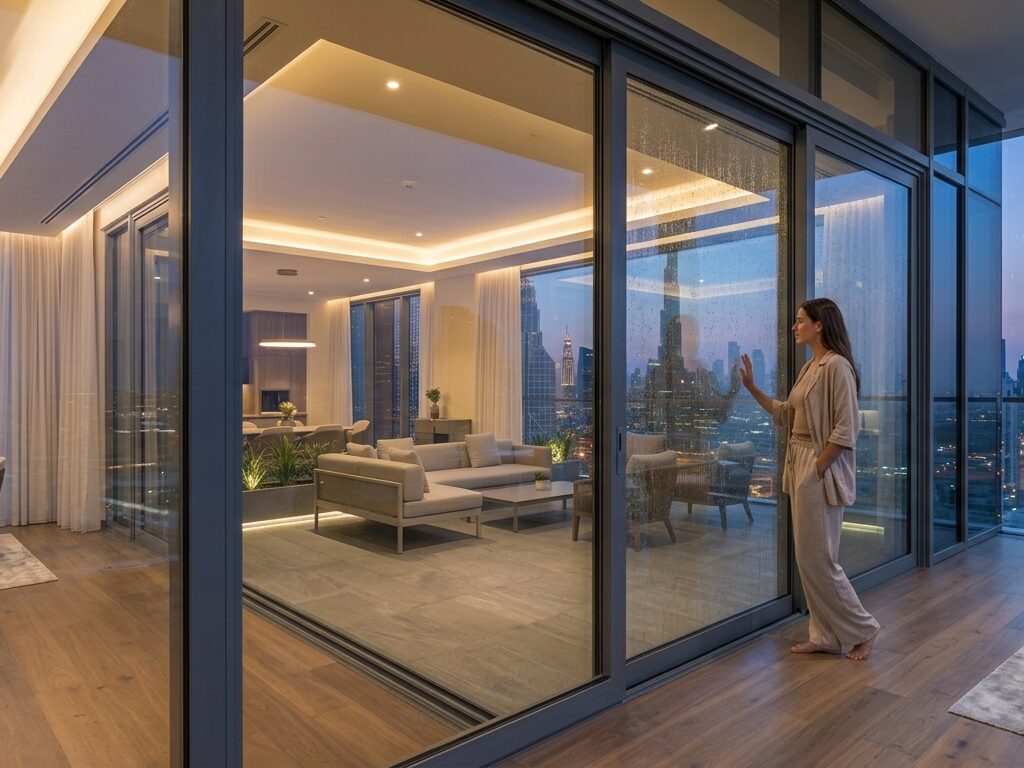
Two architectural heavyweights dominate modern residential design: sliding glass doors and bi-fold aluminum doors. While both flood your interiors with natural light and deliver expansive views, their spatial footprints, opening mechanisms, and lifestyle advantages differ significantly.
In this ultimate space-saving guide, we break down how sliding and bi-fold aluminum doors compare across room geometry, thermal efficiency, daily functionality, maintenance, and return on investment.
1. Mechanism & Spatial Dynamics: How They Open and Operate
The most fundamental difference between the two systems comes down to how they use your floor and wall space.
Sliding Glass Doors: The Zero-Clearance Solution
Sliding doors operate horizontally along an integrated top and bottom track system. Panels glide smoothly past one another, remaining strictly within the plane of the wall.
- Clearance Needed: Zero interior or exterior swing space required.
- Maximum Open Area: Typically 50% to 66% of the total structural opening (unless designed as pocket doors that slide entirely into the wall cavity).
- Ideal Floorplans: Narrow balconies, compact apartment living rooms, tight patio clearances, and rooms where furniture sits close to the threshold.
Bi-Fold Aluminum Doors: The 90%+ Panoramic Opener
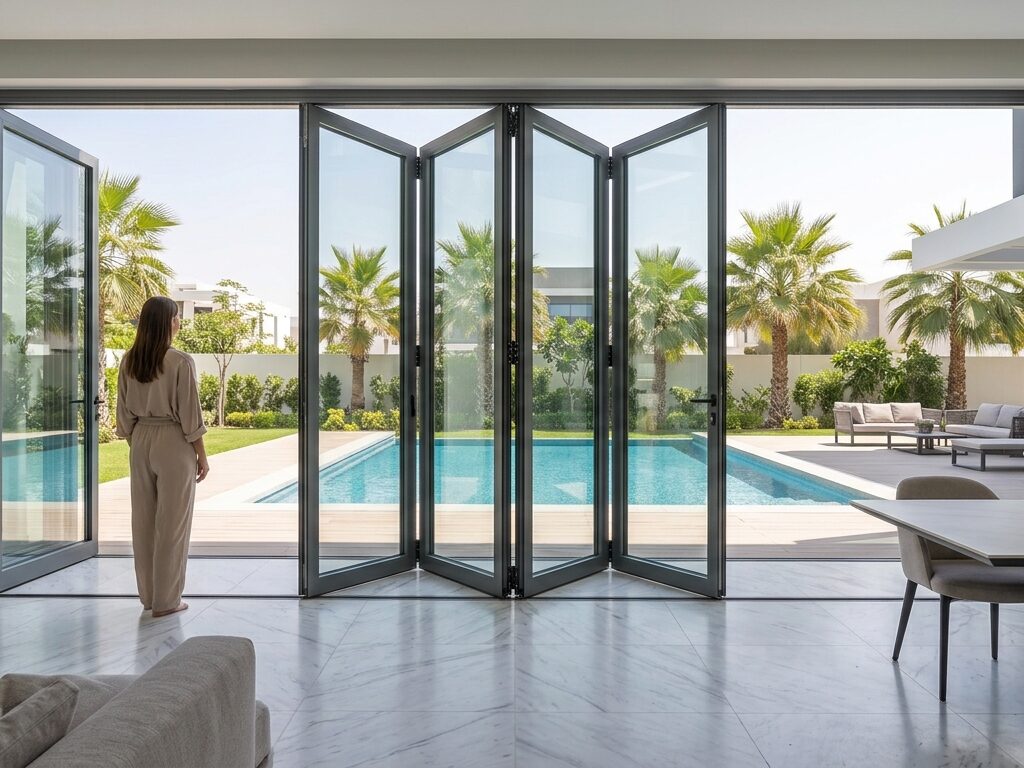
Bi-fold (or accordion) doors consist of multiple hinged panels engineered with precision aluminum frames. When pushed open, the panels fold back like a concertina, stacking neatly against one or both sides of the structural opening.
- Clearance Needed: Requires a dedicated “folding zone” (swing radius) either outward onto the patio or inward into the room.
- Maximum Open Area: Up to 90%–95% unobstructed, seamless opening.
- Ideal Floorplans: Wide villa terraces, outdoor entertainment areas, expansive garden courtyards, and open-plan transition zones.
2. Head-to-Head Comparison: Sliding vs. Bi-Fold Doors
| Feature / Metric | Sliding Glass Doors | Bi-Fold Aluminum Doors |
| Sightlines & View (Closed) | Exceptional (Ultra-slim frames, huge uninterrupted glass panes) | Moderate (Multiple vertical mullions/panel joints) |
| Total Opening Capacity | 50% – 66% open width | 90% – 95% open width |
| Floor Space Efficiency | Maximum (No clearance radius needed) | Requires clear swing clearance where panels stack |
| Thermal & Acoustic Insulation | Very High (Fewer moving joints and perimeter seals) | High (Requires high-grade multi-point weather seals) |
| Threshold Options | Recessed, flush, or low-profile tracks | Flush floor tracks (seamless indoor-outdoor floor integration) |
| Everyday Quick Access | Slide open single panel partially | Dedicated “traffic/pass door” can be built into the set |
| Wind & Weather Resistance | Superior structural rigidity in high-wind zones | Excellent when engineered with high-grade multi-point locking |
3. Best Choice by Property Type: Villas vs. Apartments
A. For Apartments & Penthouses
When space is at a premium, layout efficiency dictates design choices.
- Why Sliding Doors Often Win for Apartments:
Standard apartment balconies are frequently narrow (1.2m to 2m deep). A bi-fold door that stacks outward can obstruct outdoor seating, planters, or railing walkways. Stacking inward can collide with dining tables or sofas. Sliding doors eliminate swing collision entirely. - When to Choose Bi-Folds for Apartments:
If you have a penthouse or top-floor unit with an expansive wraparound terrace, bi-folds allow you to transform the entire living area into an open-air pavilion.
B. For Villas & Townhouses
Villas typically feature larger structural openings that open directly into private gardens, pools, or shaded verandas.
- Why Bi-Fold Doors Shine in Villas:
If your goal is true indoor-outdoor entertaining, bi-folds let you host barbecues, garden parties, or pool days without barriers. Stacking the panels cleanly against the perimeter wall seamlessly unites your living room with the deck. - When to Choose Sliding Doors in Villas:
If your villa overlooks an ocean, golf course, or scenic landscape, bi-folds introduce multiple vertical frame profiles that break up the view. Oversized, minimalist sliding glass doors (with 2.5m+ panel widths and ultra-slim 20mm interlocks) deliver uninterrupted panorama framed like living art.
4. Key Factors to Evaluate Before You Buy
1. Thermal Break & Energy Efficiency
Whether dealing with extreme summer heat or winter chill, large glass surfaces heavily influence HVAC loads.
- Always specify thermally broken aluminum profiles (polyamide insulation strips that prevent heat conduction through the frame).
- Pair with Double or Triple Glazed Low-E (Low-Emissivity) Glass with Argon gas filling to minimize solar heat gain and acoustic noise.
2. Thresholds and Accessibility
- Flush Thresholds: Bi-fold doors allow for sunken floor tracks that sit completely level with your interior flooring and exterior decking, eliminating trip hazards.
- Weather-Rated Sub-Sills: If your door faces direct, wind-driven rain, make sure your flush track includes integrated drainage channels.
3. Glass-to-Frame Ratio
- If you keep your doors closed 80% of the year due to climate control, sliding doors provide larger uninterrupted panes of glass and higher natural daylight ingress.
- If you open your doors frequently during pleasant seasons, bi-fold doors deliver the ventilation and freedom of an open wall.
5. Maintenance, Longevity, and Security
- Roller Maintenance: Sliding doors have fewer moving parts, relying on durable stainless steel bottom rollers. Bi-fold doors rely on multi-point hinges, top guide tracks, and bottom carriages that require annual alignment checks and lubrication.
- Multi-Point Security: Both modern systems provide exceptional security. Bi-folds use multi-point shoot-bolt locks across every folding joint, while high-spec sliding doors feature robust anti-lift mechanisms and heavy-duty cylinder deadlocks.
Summary: Which System Fits Your Space?
| Choose Sliding Glass Doors If: | Choose Bi-Fold Aluminum Doors If: |
| You have limited clearance for folding panels | You want to open up the entire wall (90%+) |
| You want clean, uninterrupted glass views | You frequently host outdoor-indoor gatherings |
| Furniture or curtains are placed close to the wall | You want a completely seamless, step-free threshold |
| You want low-maintenance simplicity with few joints | You have a large villa veranda or deep penthouse terrace |
Ready to Elevate Your Living Space?
Transform your home with custom-engineered architectural glazing tailored to your floorplan.